

Rapid Responses
The Heavy-Duty Toolset for Stronger Coach Communications


For generations, officials have been expected to manage emotion, conflict, and criticism — with very little training on how to communicate through it.
Handling difficult coaches is one of the hardest parts of officiating — And here’s the truth: this is one of the biggest education gaps in our industry. Most officials have never been formally taught what to say, when to say it, how to say it, and how to set boundaries without escalating the game. We’ve been handed a whistle and a rulebook… and then told to “figure out the communication part.”
Historically, officiating has had a massive lack of communication training — especially around coach behavior, bench decorum, and game management. And that gap doesn’t just hurt individual officials… it contributes to the bigger picture: the officiating shortage.
Because if the job feels miserable, stressful, and confrontational — and officials don’t feel equipped to handle it — they leave.
So yes, this content will improve your game immediately. But on the macro level, if more officials learn to communicate with the same standards and the same approach, it helps the entire sport. Conflict drops. Respect rises. And our jobs get easier when we’re all on the same page.
What started in 2019 as a few catchy one-liners to de-escalate coaches has transformed into something much bigger:
a complete game management system and a highly effective communication approach that helps you lead the game — not react to it.
Rapid Response = A Complete Communication System
When we say “rapid response,” we’re not talking about a cute phrase or a quick comeback.
Rapid Responses are built to help you do three things, consistently:
De-escalate tension without giving away authority
Deliver sportsmanship messages when behavior inches towards the line
Assert communication standards so the game can keep moving
At its core, this is about setting expectations — boundaries around how coaches can talk to you and how you’ll handle the interaction. Because boundaries only work when they’re stated clearly, and backed by follow-through.
Now, some people will blow through boundaries no matter what.
But we dramatically increase the odds of boundaries being respected when we assert them early and consistently.
That’s what Rapid Responses do.
They’re about running the game, protecting the crew, and creating a standard that most coaches will adjust to once they know exactly where the line is.
An important truth that often gets lost
Officials are not obligated to explain calls to coaches. That requirement does not exist in any rulebook. Communication is an unwritten courtesy — one that works best when it’s rooted in respect.
When that respect isn’t present, dialogue isn’t helpful and shouldn’t be expected. In fact, constant arguing, commenting, or seeking “explanations” that aren’t truly wanted becomes counterproductive. Many times, the coach asking for an explanation isn’t interested in information — they’re expressing disagreement. That’s not communication; that’s commentary.
This leads to an another concept officials need to think about: access. Are you giving coaches too much access to you, your time, and your attention? Make them earn the access through good sportsmanship.
3 POWER Words to Start a Firm Response💪🏽
Let’s start this article with one of the heaviest tools in the set.
This isn’t a line you open with on the first interaction. This is a later-game tool — after some wear and tear, after the coach has pushed, tested, or applied pressure in a way they would never tolerate from you.
Because that’s the reality: a coach may shout, wave you off, show you up, or talk to you in a tone they’d never use in their 9–5. And once that line is crossed, you need something that re-centers the standard.
“I would never…”
Then fill in the blank based on the behavior you’re addressing.
Examples:
🗣️ “Coach, I would never shout at you from across the court.”
🗣️ “Coach, I would never disrespect you like that.”
🗣️ “Coach, I would never treat you unprofessionally. Please show me the same 2-way respect.”
This is how we reset expectations and protect the game. And yes — some coaches will blow through boundaries no matter what. But you increase the odds of compliance when you assert the boundary clearly and confidently.
So the next time you feel stuck, remember the three words that do the heavy lifting:
I would never.
Protect the Crew: When They Criticize Your Partner🤝
This is where partnering needs an upgrade across the board.
When a coach is disrespectfully addressing your partner, too many officials:
look the other way
ignore it
or tell themselves, “That’s not my responsibility — he’s talking to my partner, not me.”
That mindset is a problem.
This is where we need more firmness and more togetherness.
And we’ve found a highly effective rapid response in this moment — one that has worked 99% of the time because it evokes empathy, resets the standard, and often causes the coach to apologize. That’s a great spot to be in because now you’ve established respect and you’re back in control.
The next time a coach says “Hey Ref, you gotta help your partner out—he is bad.”
Use this:
“Coach, with all due respect, I would never criticize your assistant coaches or make negative comments about your staff. Please have the same respect for me and my crew. Is that fair?”
If you want your crew to run the game, you have to protect the crew. The fastest way to lose control is to let a coach disrespect one official while the other pretends it’s not happening.
Stop Using Weak Phrases—Upgrade Your Language
Words matter — a lot more than most officials realize.
In heated moments, your language is either building credibility, or giving the coach more room to argue.
A big part of strong coach communication isn’t saying more… it’s saying better. Here are simple swaps that instantly make you sound more professional and composed:
❌ “It’s not my area.”
✅ “I had an engaged matchup in my primary, so I wasn’t looking in that area.”
❌ “That’s not my call.”
✅ “I’m going to trust my partner on that play.”
❌ “I didn’t see it.” (one of the worst ones)
✅ “From my angle, I didn’t have an open look — and I didn’t want to guess.”
❌ “I don’t know.”
✅ “I’m not 100% certain.”
❌ “Go watch the film.”
✅ “I appreciate your perspective — what did you see?”
❌ “I got the call right.”
✅ “I feel good about the decision — but I could be wrong.”
❌ “Calm down.” (never works)
✅ “I’ll listen — but we’re going to keep it respectful.”
❌ “You’re wrong, Coach.”
✅ “You could be right.”
How to get them to STOP shouting at you🛑
This is one of the most common stress points in officiating: a coach shouting across the court, yelling at you in transition, or demanding an explanation at a volume that turns the gym into their stage.
Here’s the problem: when we engage that energy, we reward it. And when we ignore it without setting a standard, it keeps happening.
The solution is simple: stay calm, stay professional, and set the boundary. Not with attitude — with presence.
Here’s 3 Golden rapid responses that are tried and true:
🗣️ “Coach, we’re very approachable if you have a question at the right time — but we’re not going to tolerate shouting across the court at us. We would never shout across the court at you. All we’re asking for is two-way respect. Can you work with us here?”
🗣️“Coach, I don’t respond to that volume. I’m happy to have a conversation about the play, but it needs to be done in a respectful manner. Is that fair?”
🗣️“Please stop shouting at me. That’s not a respectful way to communicate.”
Coaches aren’t trying to fight you — they’re testing where your line is. When you define it early and confidently, the majority adjust.
Foul Count Complaints= Automatic Permission to Shut it Down Immediately❌
When a coach starts talking foul count — “It’s 8–2! You’ve gotta even this up!” — understand what’s really happening.
That’s not appropriate communication. That’s gamesmanship.
It’s also unsporting behavior because it questions the crew’s integrity and attempts to influence decision-making using the scoreboard. And if you don’t address it, you silently allow the coach to keep going down that road.
Here’s the proven go-to rapid responses we recommend:
🗣️“Coach, we’re very aware of the time, score, and foul count — and we’re not discussing the numbers on the scoreboard. If you have a question about a specific play, I’m happy to answer it.”
🗣️“Coach, we’re NOT talking about the foul count again. Do you have a question about a specific play?”

Stop Letting the Coaches Referee in your Ear👂
It happens more often than we admit — especially when you’re table-side in the center position, the play is developing, and a coach is standing right behind you saying things like:
“𝘛𝘩𝘢𝘵’𝘴 𝘢 𝘧𝘰𝘶𝘭.”
“𝘏𝘦 𝘨𝘰𝘵 𝘩𝘪𝘵.”
“𝘠𝘰𝘶’𝘷𝘦 𝘨𝘰𝘵𝘵𝘢 𝘤𝘢𝘭𝘭 𝘵𝘩𝘢𝘵.”
Let’s be clear: that is them trying to influence our decisions (which is unsportsmanlike conduct). And it’s happening at the exact moment you’re trying to process the legality of the play. The play is hard enough to officiate without a voice in your ear attempting to steer your decision in real time.
When officials allow this to go unchecked, it becomes normalized. And once it’s normalized, it becomes expected. That’s when the game starts slipping away from us. and the game always comes FIRST.
Live-ball commentary from the bench is a distraction, and distractions directly impact accuracy.
Here are some tools from the set:
🗣️ “𝘊𝘰𝘢𝘤𝘩, please STOP 𝘳𝘦𝘧𝘧𝘪𝘯𝘨 𝘪𝘯 𝘮𝘺 𝘦𝘢𝘳. 𝘐 𝘸𝘰𝘶𝘭𝘥 𝘯𝘦𝘷𝘦𝘳 𝘤𝘰𝘢𝘤𝘩 𝘪𝘯 𝘺𝘰𝘶𝘳 𝘦𝘢𝘳.”
🗣️ “Coach, if you have a question, I’m happy to address it during a dead ball. I need to concentrate during live play.”
🗣️ “Coach, I’m not going to allow distractions during a live ball. Please don’t talk to me while the play is going.”
🗣️ “Coach, I would never distract you while you’re coaching. Please don’t distract me while I’m officiating.”
A Communication Shift That Changes Everything
You’re not out there to prove the call was correct. Your job isn’t to convince the coach. We deliver a rule-based explanation, then move on. The moment you go back and forth, you’ve turned a decision into a debate.
Conviction > convincing.
Convincing invites rebuttal. Conviction sets the standard.
And here’s the key: coaches are allowed to disagree. They’re allowed to be frustrated at you. They’re allowed to be disappointed in your performance. We need more emotional discipline to stop seeking their approval.
When Coaches Go Broad, You Go Narrow🎯
Coaches love broad, vague language when they’re frustrated:
“Ref, that’s a foul everytime!”
“You’re missing a TON on this end!”
“We’re getting nothing!”
“You missed a foul on that end and then call that. What exactly is a foul tonight?”
Broad statements are emotional. They’re not actionable. And if you respond to broad language with broad language, you get stuck in an endless argument.
Here’s the communication advantage we have as officials: we can force specificity-And that is where your leverage lives.
So when a coach goes broad, you go narrow:
🗣️ “I saw the defender maintain their verticality. What did you think the defender did wrong.”
🗣️ “I hear you, Coach. Do you have a specific play you’d like to discuss?”
Most of the time, coaches don’t have a specific play — they have frustration. And once you require a play, the rant dies out and the game keeps moving.
And if they do name a play? Perfect. Now you can answer more cleanly and precise
*Providing a rule-based explanation coupled with a question are a 2 HEAVY tools that we have at our disposal.
Exaggerated Language: Reset It Back to Reality🔁
One of the fastest ways you get pulled into communication chaos is when a coach uses exaggerated, dramatic phrases:
“HE GOT CRUSHED!”
“SHE GOT A HAMMERED!”
“WE’RE GETTING KILLED OUT HERE!”
We don’t entertain hyperbole. If you accept that framework then you’re debating a feeling instead of addressing a play.
Here’s the standard:
🗣️ “Coach, I can help you — but we’re going to use appropriate language.”
🗣️ “If you have a question about a specific play, I’m here — but we’re not using those terms.”
🗣️ “I’m happy to have a conversation with you using realistic terms. Is that fair…whats’s your question?”
Exaggeration is bait. It’s designed to trigger you into reacting, explaining, and justifying.
Refereeing a Friend? Don’t Get Stuck in the “Friend Zone”🚨
Here’s a trap that’s way more common than high school officials admit…
When you work a game with a coach you’re cool with, it’s easy to slide into friend mode during the game.
And when that happens, it quietly changes how you manage them.
You hesitate. You let comments go that you’d normally address. You “keep it moving” when you should be setting a boundary.
It might sound like…
Coach: “Hey… this guy is terrible you gotta help him out. What is he calling?”
🚩 That’s the moment the problem shows up.
Because now you’re not just officiating — you’re being pulled into a loyalty test.
And if you’re stuck in the friend zone, it becomes MUCH harder to respond the right way:
• You don’t want to “embarrass” your friend
• You don’t want it to get awkward
• You don’t want to “switch the vibe”
But here’s the irony… 👇
Not addressing it actually hurts your credibility AND the relationship.
✅ The fix: Have the conversation off the court earlier in the season about keeping it professional.
Because if you don’t set that boundary early, it’ll probably work against you in the moment. And it can even damage the friendship long-term.
Reminder: Don’t get stuck in the friend zone on the court.
The 𝟰 step approach to improving 𝗚𝗮𝗺𝗲 Management 📈
1️⃣ 𝗔𝘄𝗮𝗿𝗲𝗻𝗲𝘀𝘀 & 𝗣𝗮𝘁𝘁𝗲𝗿𝗻𝘀 📊
One of the biggest issues in managing difficult coaches is this: many officials don’t even realize it’s happening.
When coaches are commenting out loud, a lot of officials ignore it, act like they don’t hear it… and even more common than you think, they simply aren’t aware of it — and later can’t recall what was said or how often it happened.
We’re not asking you to track bench behavior like game notes (“he shouted travel at 14:22” or “waved off the no-call at 17:38”). But you do need awareness of the pattern.
Mentally recognize when, over the course of a few minutes, the coach has two or three outward reactions to decisions the crew had:
• “That’s a travel.”
• “He got fouled.”
• “Illegal screen.”
That awareness matters because it gives you context. And context tells you whether you’re dealing with a one-off comment… or a trend that needs intervention.
2️⃣ 𝗜𝗻𝗶𝘁𝗶𝗮𝘁𝗲 𝘁𝗵𝗲 𝗜𝗻𝘁𝗲𝗿𝗮𝗰𝘁𝗶𝗼𝗻 👋
Many officials are reactive instead of proactive. We hope behavior improves instead of taking action to change it.
If you want something to change, you have to initiate the interaction.
Best times to do it:
• Dead balls
• Free throws
• ✅ Best option: right after a timeout, once the team breaks the huddle
That’s when a coach is most receptive — and least defensive.
3️⃣ 𝗗𝗲𝗹𝗶𝘃𝗲𝗿 𝗮 𝗖𝗼𝗻𝘁𝗲𝘅𝘁𝘂𝗮𝗹 𝗥𝗮𝗽𝗶𝗱 𝗥𝗲𝘀𝗽𝗼𝗻𝘀𝗲 🗣️
This is where preparation wins.
You should already know the common things coaches say. The key is responding contextually, not generically. That’s why Step 1 matters.
🗣️“Coach, we’re very approachable — but shouting ‘travel’ across the court isn’t a respectful way to communicate. Now that I have the opportunity, what question can I answer for you.”
4️⃣ 𝗖𝗼𝗻𝘀𝗶𝘀𝘁𝗲𝗻𝗰𝘆 & 𝗙𝗼𝗹𝗹𝗼𝘄-𝗧𝗵𝗿𝗼𝘂𝗴𝗵 ♻️
Your work isn’t done once the conversation happens.
If you set a standard, your actions must match your words.
Continue monitoring bench decorum. Know when it’s time to stop talking — and start using the rulebook:
• Bench warning
• Technical foul
Consistency is how respect is earned.
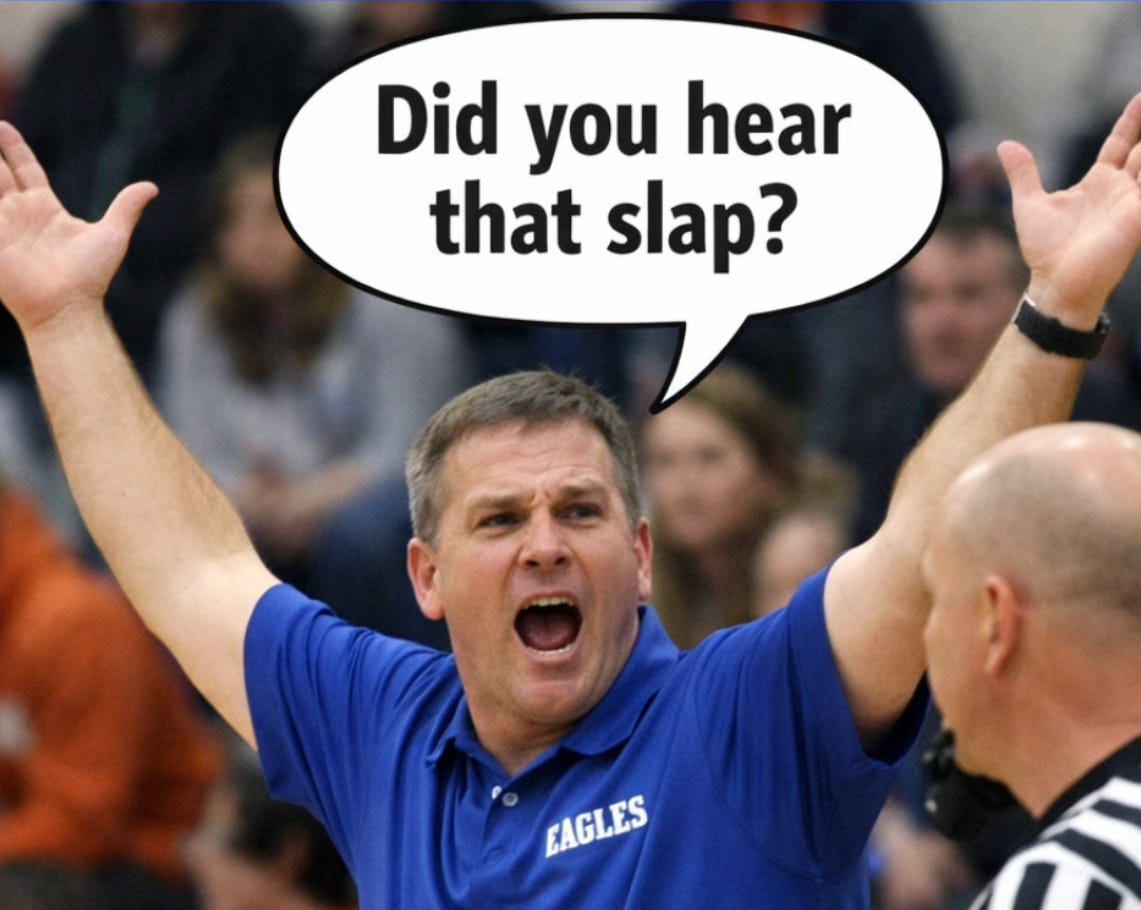
Did You Hear That Slap? We don’t referee sound🔊
🗣️“Coach, I can’t officiate off sound. I have to see the illegal contact — otherwise I’m guessing.”
🗣️“Coach, I heard the sound but I didn’t see any illegal contact. What did you see?”
🗣️“I hear you, Coach — but I have to officiate the play, not the sound.”
Know What to Ignore vs. What to Address🧠
One of the most important skills in game management is having clear filters for coach commentary.
We encourage every official reading this to develop the wherewithal to know:
which comments should be disregarded, forgotten about, and not touched
and which comments absolutely require a response
Because not every comment deserves your energy. Some remarks are just frustration leaving the body — and engaging them only opens up a useless thread.
Those comments that cannot be ignored must be addressed either:
with words (rapid response)
or with the rulebook (warning / technical foul)
Just like we judge legal vs. illegal contact, we have to judge acceptable vs. unacceptable commentary.
The Three Voices of an Effective Official🎙️
One of the simplest communication upgrades you can make is learning to use three different voices as three different tools.
Most officials only use one voice all game — and then wonder why every interaction feels the same. The best communicators know how to shift gears based on the moment.
1) Normal Voice (Your Default)
2) Authority Voice (When Standards Need to Be Set)
3) Diffusing Voice (When You Want It to Fizzle Out)
Pregame Power Point: What We Permit, We Promote
Meaning: every time we allow something — complaining, shouting, cross-court yelling, foul-count baiting, bench antics — we’re teaching the coach and the gym that it’s acceptable. And once it’s been permitted, it usually escalates.
Dictate the Terms of the Dialogue
Tie this back to the idea of access: coaches don’t automatically get full access to you, your time, or your explanations. You dictate the terms — what you’ll talk about, when you’ll talk about it, and how the conversation will happen.
Here’s a key tip we recommend: sportsmanship before explanations. If a coach is demanding an explanation in a disrespectful way, we’re not talking about the play anymore — we’re addressing behavior. Don’t give the explanation without also addressing sportsmanship.
That being said, if a coach is asking respectfully, we should always be willing to provide a brief explanation. Rapid Responses aren’t designed for the compliant, respectful coaches — they’re for the moments when standards need to be set.
The point is simple: you are not obligated to provide information just because a coach asks for it. You’re obligated to run the game. And when you control the terms — when/where/what — you protect the crew and train coaches to communicate the right way if they want access to you.